Why Does My Child Melt Down After School?
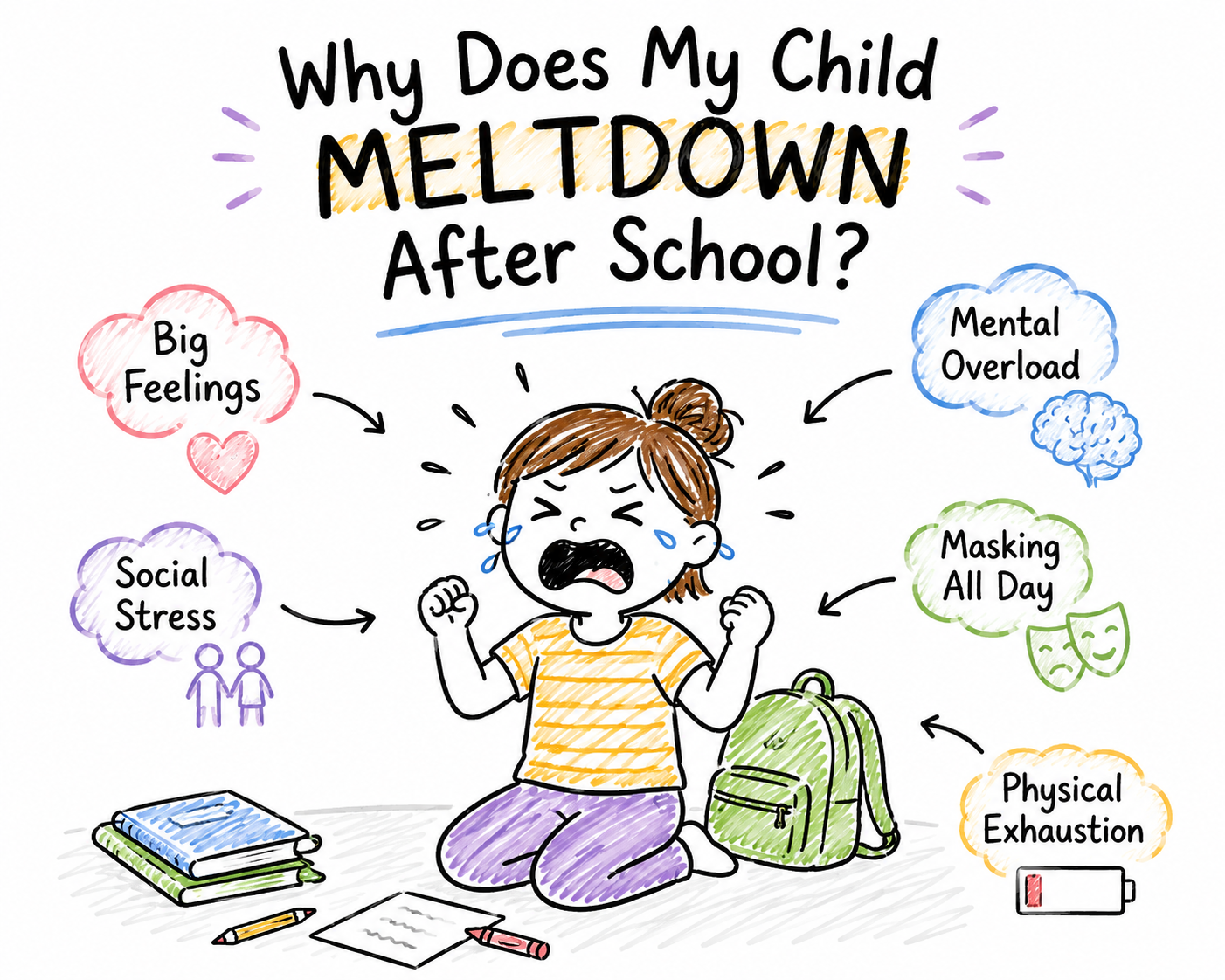
If your child comes home from school and suddenly falls apart over something tiny like the wrong snack, a sibling breathing too loudly, or being asked about their day, you are definitely not alone.
Many parents describe this moment as “after-school restraint collapse.” In simple terms, it means your child has spent the entire school day holding it together, following directions, managing emotions, navigating social situations, and meeting expectations. Once they finally get home to their safe place, all of that built-up stress spills out.
It can feel confusing because teachers may report that your child was “great all day,” while you’re dealing with tears, anger, whining, shutdowns, or explosive behavior at home. Both things can be true.
Your child may simply be emotionally exhausted.
What Causes After-School Meltdowns?
School requires a huge amount of mental, emotional, and physical energy from kids. Even children who enjoy school can become overwhelmed by the constant demands.
Throughout the day, children are expected to:
Pay attention for long periods of time
Follow directions quickly
Handle academic pressure
Navigate friendships and social stress
Manage sensory input like noise, lights, and crowds
Control impulses and emotions
Transition between tasks repeatedly
For children with ADHD, anxiety, autism, sensory sensitivities, learning differences, or emotional regulation challenges, this effort can be even more draining.
Think of it like carrying a backpack that slowly gets heavier throughout the day. By the time they walk through the front door, their emotional “muscles” are tired.
Home is where they finally let the backpack down.
What Meltdowns Can Look Like
After-school meltdowns do not always look dramatic. Sometimes they show up as:
Irritability or arguing
Crying over small things
Clinginess
Complaining of headaches or stomachaches
Shutting down or hiding in their room
Hyperactivity or silliness
Defiance
Emotional outbursts
Saying “I hate school” even if they usually enjoy it
Some children need to release energy loudly, while others completely withdraw.
What NOT to Do
When your child melts down, it is easy to jump into problem-solving mode immediately. But asking lots of questions or correcting behavior too quickly can accidentally add more pressure to an already overwhelmed nervous system.
Try to avoid:
Firing off questions the second they get in the car
Lecturing during the meltdown
Assuming they are being intentionally disrespectful
Comparing home behavior to school behavior
Taking the meltdown personally
Most of the time, your child is not trying to give you a hard time. They are having a hard time.
What Helps Instead
1. Build in a “decompression period”
Many kids need 20–45 minutes of low-demand time after school.
This might look like:
Snack and quiet TV time
Playing outside
Listening to music
Drawing or building
Swinging, jumping, or movement
Sitting alone for a bit
Try to keep demands low during this transition time when possible.
2. Don’t force conversation immediately
Some children need time before talking about their day. Instead of “How was school?” try:
“I’m glad you’re home.”
“You worked hard today.”
“You can tell me about your day whenever you’re ready.”
This lowers pressure and keeps connection open.
3. Watch for patterns
Pay attention to when meltdowns happen most often.
Are they worse:
On certain school days?
After tests?
After social conflicts?
When your child is hungry or tired?
After extracurricular activities?
Patterns can give important clues about what is overwhelming your child.
4. Focus on regulation before correction
A dysregulated child cannot learn effectively in the middle of a meltdown.
Before addressing behavior, help your child feel calm and safe first. That might mean:
Sitting nearby quietly
Offering water or a snack
Giving physical space
Using a calm voice
Helping them move their body
Once their nervous system settles, problem-solving becomes much more effective.
When to Seek Additional Support
Occasional after-school meltdowns are very common. But if your child’s distress is intense, frequent, or interfering with daily life, additional support may help.
A therapist, counselor, or pediatrician can help determine whether anxiety, ADHD, sensory challenges, emotional regulation difficulties, or school stress may be contributing.
Sometimes the meltdown is not “bad behavior.” It is a signal that your child’s brain and body are overloaded.
Final Thoughts
After-school meltdowns can be exhausting for parents, especially when you are also tired at the end of the day. But these moments often tell us something important: your child feels safe enough with you to let their guard down.
That does not mean you should allow harmful behavior without limits. But understanding the “why” behind the meltdown can help you respond with more calm, connection, and confidence.
Sometimes what children need most after school is not more questions, corrections, or expectations.
Sometimes they just need a soft place to land.